
 |
According
to the Federal Network Agency, German electricity grid operators
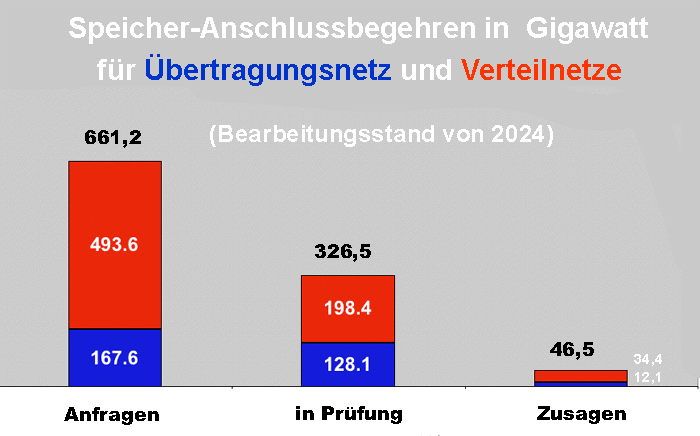
received a total of 9,710 applications for grid connections for battery
storage systems last year, adding up to a total capacity of 661.2
gigawatts. Of these, 4,261 with 326.5 gigawatts were still under review.
A total of 3,818 applications with a capacity of 46.5 gigawatts that
had been received in 2004 or earlier were approved. If all of these
approved projects were actually implemented, this would result in a
twentyfold increase in the currently installed battery storage capacity
of 2.3 gigawatts.
|
“Storage tsunami” floods electricity grid operators
German electricity grid operators are facing "a veritable tsunami
of storage connection requests”. This is how the East German transmission
system operator 50Hertz described the situation when it published a statement
on the “ramp-up of large-scale battery storage” a few months ago. At that
time, it estimated its own intake of project requests at 100 gigawatts (GW).
By mid-November, this had risen to 150 GW. By way of comparison, the total
output of all power plants installed in Germany for public electricity supply
is around 250 GW.
And 50Hertz is only one of four transmission system operators.
Amprion, TenneT, and TransnetBW are not quite as overwhelmed with relevant
inquiries, but the total would at least double if these were added. This total
capacity alone would be enough to cover Germany's entire electricity needs
and more from battery storage until capacities are exhausted.
Last year, there were a total of 9710 inquiries with a total capacity of 661,2 gigawatts
In addition, below the transmission level (220 and 380 kV),
there are many more applicants in the distribution networks who want to connect
a battery storage system to medium voltage (more than 1 kV) or high voltage
(100 kV). According to a survey published by the Federal Network Agency on
November 12, distribution network operators received a total of 9,212 requests
with a capacity of 493.6 GW last year (unfortunately, more recent data is
not available), of which 1,568 with 260.8 GW were still pending, 3,854 with
198.4 GW were under review, and 3,790 with 34.4 GW had been approved. Transmission
system operators received 498 requests totaling 167.6 GW, of which 63 (27.4
GW) were still pending, 407 (128.1 GW) were under review, and 28 (12.1 GW)
had been approved (see Charts).
The implementation of all applications approved in 2024 would
increase battery storage capacity twentyfold
According to this announcement by the Federal Network Agency,
the market master data register currently lists 921 battery storage facilities
with a connection from the medium-voltage level upwards. These systems have
a net nominal capacity of around 2.3 GW and a storage capacity of around 3.2
GWh. If only the 3,818 projects approved in 2024 with 46.5 GW were to be implemented,
this would correspond to “a multiplication of the current stock,” as the Federal
Network Agency notes. Or, to put it in concrete terms: the number of plants
would increase from 921 to 4,739, i.e., fivefold, and their capacity from
2.3 GW to 48.8 GW, i.e., more than twentyfold.
Many project developers submit the same application for several
locations
In its paper on the “ramp-up of large-scale battery storage,”
50Hertz cites the following reasons for the boom:
- In recent years, the prices of battery cells and thus the costs of manufacturing
large-scale battery storage systems have fallen sharply.
- At the same time, the spread of electricity exchange prices has increased,
mainly due to the boom in photovoltaic expansion.
- The exemption of grid-connected electricity storage facilities from
grid fees, which was initially set to expire in August 2026, has been
extended by three years until 2029.
At the same time, the rapid increase in battery connection
applications to the transmission grid is due to the fact that the business
model of the operators of such plants – i.e., the exploitation of short-term
price fluctuations on the electricity market – is becoming less lucrative
with each newly connected battery. The earlier a storage facility is connected,
the more it can benefit from price differences. The resulting competition
for the earliest possible grid connection is driving up land prices at potential
storage sites, with the result that real estate owners and speculators who
have no project experience in the energy sector are also submitting their
own applications. Since there are currently no costs associated with a connection
request, many project developers are also submitting the same application
for several locations in order to increase their chances of being awarded
a contract somewhere.
The current grid connection procedure urgently needs to be
reformed
The East German transmission system operator considers a fundamental
reform of the grid connection procedure to be necessary, as also called for
by the Bundestag in a resolution on November 13 (251102).
In the case of multiple applications for the same grid connection point, prioritization
should no longer be based on a “first come, first served” basis, but on the
proven maturity of the project. Above all, the entire Power Plant Grid Connection
Ordinance (KraftNAV) should no longer be applied to battery storage systems
– a demand that the Bundesrat also supports and wanted to include in the recently
adopted amendment to the Energy Industry Act (EnWG). Although this did not
happen, the state representatives may have provided the impetus for the aforementioned
resolution, which calls on the federal government to fundamentally reform
the grid connection procedure.
At the time, the KraftNAV was intended for ten applications
for power plant connections per year.
The KraftNAV dates back to 2007 and regulates the connection
of generation plants from 100 MW and 110 kV. It was tailored exclusively to
power plants. At that time, grid-connected battery storage systems were practically
non-existent, apart from a small number of home storage systems that were
not subject to approval and did not feed their negligible amounts of electricity
back into the grid. It was not until seven years later that grid-connected
battery storage systems appeared in the statistics for the first time, with
a minimum value of 0.01 GW (see tables).
In the absence of any legal basis other than the KraftNAV,
the connection applications for these few battery storage systems, which with
some effort could also be classified as “generation plants,” were treated
in the same way as power plants. It is possible that a false analogy was made
with pumped storage power plants, as suggested by the word “storage.”
No wonder, then, that the current flood of applications is
overwhelming the electricity grid operators. According to the explanatory
memorandum to the law at the time, the KraftNAV was intended for around ten
applications for power plant connections per year. In the case of 50Hertz,
that would correspond to two to three applications per year. In fact, however,
the East German transmission system operator is struggling with a flood of
applications in the triple digits.
For arbitrage transactions on the electricity exchange, the
pie gets smaller with every plant
Presumably, the “storage tsunami” consists of more foam than
water. Common sense and basic arithmetic tell us that. Because if such a huge
number of connection applications were actually approved and even only mostly
realized, the operators of the plants would have to cannibalize each other
and still would not be satisfied. Of course, a distinction must be made between
necessary or at least “grid-friendly” plants, which always have a chance,
and purely commercial projects, which are essentially only aimed at arbitrage
transactions on the electricity exchange. For the latter, the pie gets smaller
with every new plant. For the time being, it will be important not to simply
process the flood of applications chronologically on a “first come, first
served” basis, but to make a preliminary selection that separates the wheat
from the chaff.
Links (internal)
- German Bundestag calls for fundamental reform of grid connection procedure
(251102)
- Outdoor storage facilities for electricity, heat, and hydrogen will
also be given priority in the future (251103
)
- List
of links on electricity storage / batteries / electrolysis
/ energy coupling
Background
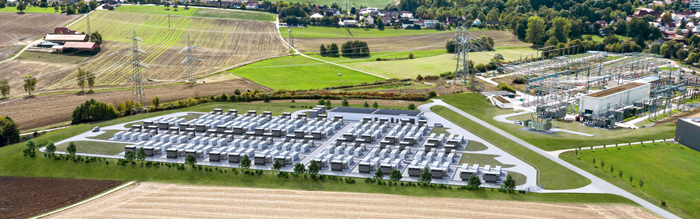 |
This
is what the 250 MW battery storage facility at the Kupferzell
substation (right) will look like when TransnetBW puts it into operation
next year. However, it may only use it for so-called redispatch or as a
“fully integrated grid component,” as Section 7 of the Energy Industry
Act (EnwG) prohibits electricity grid operators from “owning,
constructing, managing, or operating an energy storage facility.”
|
What was once “the world's largest battery storage facility”
would be a mere dwarf today
Battery
storage facilities played an important role in the early days of
electricity supply. The first power plants, which were able to generate
electrical energy on a large scale for the first time using the dynamo
principle discovered by Werner Siemens in 1866, were still quite prone
to failure and comparatively inefficient. It was therefore fortunate
that the first “accumulators” came onto the market at the same time as
the first local power grids. These were a further development of the
long-established “galvanic cells,” which were designed according to
different chemical formulas so that energy could be converted into
electricity when needed. However, this only happened until the chemical
energy potential was exhausted (as is still the case today with simple
flashlight batteries).
With
a modified design of the cells, it was now possible to make this energy
conversion reversible. This meant that the accumulators could be both
discharged and recharged. By connecting them to the generators of the
power plants—which initially only produced direct current anyway—it was
possible to bridge the still frequent power outages, at least in the
short term, or to increase the power plant's output at nightfall by
connecting the accumulators. In the beginning, electricity was used
almost exclusively for electric lighting.
Pumped storage power plants and alternating current replaced
battery storage
With
the increase in consumption, power plant output, security of supply,
and the networking of local structures, battery storage played an
increasingly minor role in the power supply. This was ensured by pumped
storage power plants, which the large state and regional suppliers used
to protect their respective grids against load fluctuations. In
addition, battery storage systems were not compatible with alternating
current, which replaced direct current across the board after World War
II at the latest. Storing alternating current in accumulators and then
converting it back into alternating current would have required complex
converters or power converters. Despite the high costs, however, the
efficiency would have been lower than with modern semiconductor-based
power converters, which today enable battery storage systems to be
connected to all levels of the power grid or, as “connectors,” integrate
high-voltage direct current (HVDC) transmissions into the transmission
grid. Due to this discrepancy between cost and benefit, battery storage
systems became less and less useful for the power grid and eventually
disappeared almost completely.
 |
|
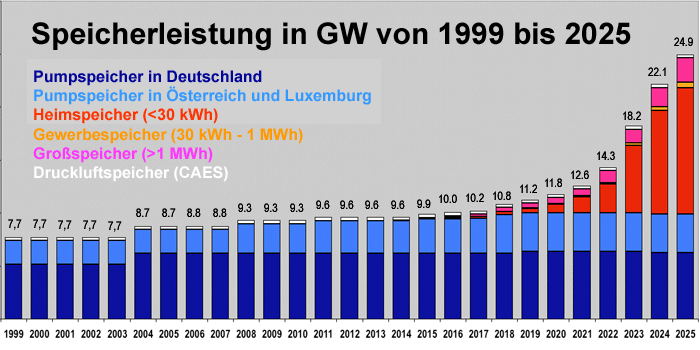
Until around 2014, storage power in the German power grid consisted
solely of pumped storage power plants located in Germany and, to a large
extent, in Austria and Luxembourg, as well as the only compressed air
storage facility. Then more and more battery storage facilities were
connected to the grid. These were mainly small “home storage” facilities
with a capacity of up to 30 kilowatt hours, which do not require
special approval but only need to be registered (red). Since 2025, the
cumulative power of these home storage systems in gigawatt has even
exceeded that
of all pumped storage power plants. However, large storage systems with
capacities of 1 MWh or more, which are taken from the grid for
commercial or technical reasons and fed back into the grid at a later
time, are more significant for grid operation. (See table for data on
this graph)
|
Only Bewag operated a battery storage facility for nine years
that was gigantic by the standards of the time
However,
there was one notable exception: in 1986, Berlin-based Bewag
commissioned a battery storage facility that was gigantic by the
standards of the time. There was a specific reason for this: West Berlin
had become an electricity island since 1952. As early as 1948/49, due
to the Soviet blockade of land and water connections that lasted almost a
year, even coal for power plants had to be flown in by airlift. Under
these circumstances, it seemed sensible to build a conventional battery
storage facility that was connected to the 30 kV distribution network
via power converters in order to support the frequency maintenance of
the island power grid.
As
a precaution, it was decided to first build a test facility with a
modest output of 24 kilowatts, which went into operation in 1981. After a
successful three-year test phase, construction of a battery storage
facility with 700 times the output began in 1984. The plant in the
former Steglitz power station consisted of conventional lead-acid
batteries with a total of 7,080 cells, which were connected in series in
twelve strings of 590 cells each. This increased the cell voltages from
around 2 volts to a total of 1,200 volts. By connecting the strings in
parallel, the capacity of the battery was increased twelvefold. After
conversion to alternating current and feeding into the 30-kV
distribution network, this resulted in an output of 17 MW, which could
be fed into the grid for twenty minutes or, at most, half an hour.
When
this plant went into operation in 1986, it was undoubtedly the largest
battery storage facility in Germany. It may even have been “the largest
battery storage facility in the world,” as another superlative claimed.
It is now a thing of the past, because after reunification and the
incorporation of Berlin into the new all-German grid (941210), the battery storage facility was no longer needed and was shut down at the end of 1994 due to unprofitability.
It took until 2014 before large-scale battery storage facilities
with a total capacity of 0.01 MWh appeared in the statistics for the first time.
Before
a new storage boom began, two decades passed in which this sector was
completely stagnant. The available current statistics, which begin in
1999 (see tables), show only gaps for all three categories of battery
storage until 2004. It was not until 2005 that the minimum value of 0.01
GW or 0.01 GWh was reported for home storage (less than 30 kWh), which
then remained unchanged for seven years. Nine years later, in 2014, the
previous gaps for commercial storage (30 kWh to 1 MWh) and large-scale
storage (more than 1 MWh) were also filled with the minimum value for
the first time.
But
then the power and capacity figures for all three categories increased
from year to year, albeit in varying increments. In 2020, the interim
result is that home storage accounts for 1.60 GWh, commercial storage
for 0.13 MWh, and large-scale storage for 0.61 GWh. Together, this
amounts to 2.34 GWh, representing an approximately eighty-fold increase
in capacity within six years. Nevertheless, this is just 4 percent of
the total 58.27 GWh of electricity storage capacity, 95 percent of which
is still provided by pumped storage power plants. The remaining 1
percent is regularly accounted for by Germany's only compressed air
storage power plant (100108) in the 27-year statistics.
 |
|
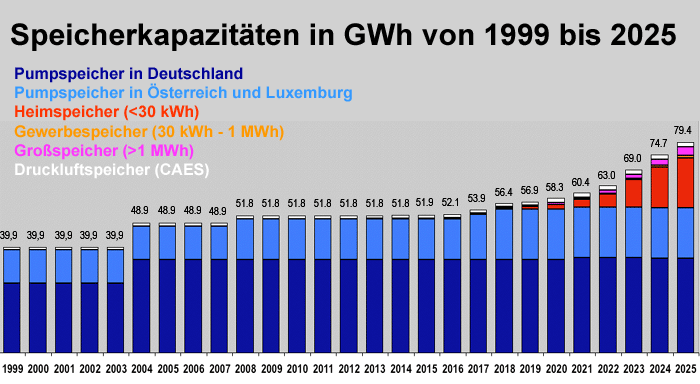
When compared with the previous chart,
the difference between the measured variables “power” (in gigawatts)
and “capacity” (in gigawatt hours) becomes clear: although home storage
systems (red) now have a greater total power output than pumped storage
power plants, they are still far from reaching their capacity. So far,
they have played no role in grid control. However, this could change if
one day home storage systems, including the capacities of electric cars,
were combined to form large virtual storage facilities. (See table for
data on this chart)
|
Home storage systems now have more power than all pumped
storage power plants combined, but they are still a long way from matching their
capacity.
Another
five years later, i.e. today, battery storage systems have caught up at
lightning speed. Their total output currently amounts to around 15 GW
and their total storage capacity to 23 GWh. As before, the vast majority
of this is accounted for by home storage systems. Their total output
has risen from 0.84 to 11.91 GW since 2020, with capacity increasing
from 1.60 to 18.75 GWh. This means that they even have 2 GW more
installed capacity than all pumped storage power plants (9.90 GW). In
terms of capacity, however, they are still literally nowhere near
matching them, as pumped storage power plants have a total of 54.58 GWh
of stored kinetic energy, while the chemically stored energy of all
battery storage systems combined only amounts to 23.16 GWh of
electricity.
A
look at the ENERGY CHRONICLE reveals the following projects, listed in
chronological order from 2013 onwards. They illustrate not only the
technical dimensions of large-scale and home storage systems, but also
the different purposes for which they can be used. It also becomes clear
who offers, operates, or finances such storage systems:
- Wemag builds battery storage systems for primary control (131010)
- First battery storage system for primary control in operation (140914)
- Tesla offers electricity storage systems for domestic use (150509)
- Battery power storage system with a capacity of 5 megawatts under construction (150812)
- Lead-acid battery buffers solar park and provides 1.3 MW of primary control power
(150812)
- E.ON sells power storage systems for domestic use (160413)
- Wemag triples battery storage capacity (170715)
- Giant battery in Chemnitz stores up to 16 megawatt hours (170814)
- RWE commissions battery storage for primary control (180212)
- EnBW commissions its first battery storage facility (180408)
- Virtual battery storage approved for primary control (181214)
- TransnetBW plans 250 MW battery storage facility (201207)
- RWE builds 235 MWh battery storage facility (230610)
- VW uses old electric car batteries for spot market electricity trading (230707)
- Battery storage facility in Saxony-Anhalt to have a capacity of 600 megawatt hours (230708)
- Swiss investors finance 100 MW battery storage facility in the Fichtelgebirge mountains (241108)
Commercial operation is generally in harmony with grid requirements
The
latter project in particular, in which foreign investors are financing a
100 MW battery storage facility in the Bavarian Fichtelgebirge
mountains, is a clear example of how grid considerations and
requirements often play only a secondary role in the construction of
such large-scale storage facilities. Of course, the project should have a
grid-related benefit that can be used as an argument for it to be
approved in the first place. However, the main motive of the operators
is usually purely financial interest in exploiting the daily
fluctuations in the stock market price of electricity for arbitrage
transactions: The aim is to buy electricity as cheaply as possible when
the exchange price is low or even negative, and then sell it back on the
exchange when the spot market price is as high as possible. This does
not rule out the possibility of agreeing to provide a specific grid
service, such as the provision of balancing energy.
Such
storage facilities are not primarily used to balance load fluctuations,
but to generate profits. Nevertheless, the grid effect is usually
similar in practice, because the price signals on the spot market that
trigger it are themselves caused by the short-term foreseeable shortage
or surplus of available power plant capacity. However, there are also
situations in which the purely commercial operation of a storage
facility can run counter to grid requirements.
Electricity grid operators are not permitted to own battery
storage facilities themselves
 |
Larger solar parks are now generally equipped with battery storage
facilities in order to be able to feed electricity into the grid and
generate income from it in a more flexible manner. In
this photo, a crane is transporting one of the typical containers in
which the battery cells are housed to its new location, where two other
modules of this type are already in place.
Photos (2): EnBW
|
However,
Section 7 of the Energy Industry Act (EnwG) prohibits electricity grid
operators from “owning, constructing, managing, or operating an energy
storage facility.” This applies in particular to transmission system
operators. This is due to the fundamental separation of ownership of
electricity generation from the grid and distribution sector, which was
introduced with the liberalization of the energy market. The only
exceptions to this are energy suppliers with up to 100,000 customers,
i.e., small to medium-sized municipal utilities.
Larger
grid operators can therefore only put out a tender for the construction
of an electricity storage facility, which is then owned by a third
party and operated by that party in accordance with the agreements made
in advance. In November, Nuremberg-based N-ERGIE Netz GmbH launched a
tender for a “grid-friendly” battery storage facility with a capacity of
20 MW and a capacity of 80 megawatt hours in order to make its
approximately 29,000-kilometer-long electricity distribution network,
which supplies about one-tenth of Bavaria, more flexible. However, the
investor must commit in their application to align the charging and
discharging of the storage facility with the technical requirements of
the grid.
Exemption for storage facilities that are a “fully integrated
grid component”
In
addition, since 2021, Section 11b of the EnWG has offered larger grid
operators the opportunity to become owners and operators of electricity
storage facilities if these facilities are a “fully integrated grid
component” that is necessary for grid operation and if no third party
can be found to own them. Probably the best-known example is the “grid
booster” that EnBW subsidiary TransnetBW is currently implementing at
the Kupferzell grid node and which is scheduled to go into operation
next year. This storage facility can provide 250 megawatts of power in a
matter of seconds, helping to overcome frequent grid bottlenecks via
“resdipatch.” However, it may only be used for this purpose.
The
situation is different for a battery storage facility with an output of
100 megawatts and a capacity of 100 megawatt hours, which EnBW
Kraftwerke is currently building in Marbach. As a power plant operator,
the group has a free hand in how it uses this storage facility, which
will be connected to the TransnetBW transmission grid. Above all, it can
store the output from solar or wind farms in order to feed it into the
grid at the most financially or technically favorable time (although
most solar parks are already equipped with battery storage systems).
In Philippsburg, EnBW is even planning a battery storage
facility with 400 MW and 800 MWh
When
EnBW announced the project in Marbach a year ago, it spoke of “by far
the largest battery storage facility in EnBW's generation sector to
date” – a statement that deliberately ignored TransnetBW's grid booster
in Kupferzell, which is more than twice as large (241108).
In the meantime, however, it has announced another project that
surpasses both of these: On the site of the former Philippsburg nuclear
power plant (200508), where the A-Nord / Ultranet “electricity highway” (231001)
from northern Germany will end, it plans to build a battery storage
facility with a capacity of 400 megawatts and a capacity of 800 megawatt
hours. “The large-scale project is to be realized without government
funding,” the announcement said. “In addition to the proceeds from the
sale of electricity, the storage facility is to be financed by offering
grid services.”
Compared
to the 14 megawatt hours available to the battery storage facility of
Berlin-based Bewag, which was the largest in Germany at the time and
even considered the largest in the world, this is 57 times more
capacity. Seen in this light, the giant Berlin facility shrinks to a
dwarf in retrospect. But it still belongs in the “large storage”
category, which starts at 1 MWh.
See also:
- Background: Pumped storage power plants – the stepchildren of the liberalized market (August 2014)
- Background: ADELE to the rescue: The adiabatic compressed air storage power plant (January 2010)