
 |
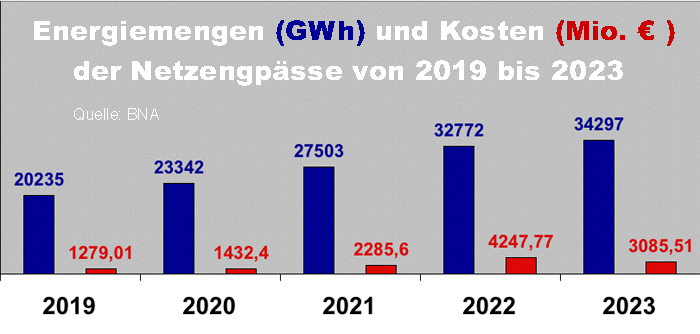
| The amount of electricity that had to be redispatch through bottlenecks
increased by a further 1,162 GWh in 2023 compared to the previous year.
Nevertheless, the total costs were 37 percent lower. Of course, this
was only because the exorbitant price level of 2022 had since returned
to something like normal. A closer look, however, shows that the costs
per gigawatt hour have also risen by around 42 percent since 2019. |
The stock market fiction of a congestion-free grid is putting
increasing pressure on electricity prices
(ref. 240704 /240705
Last year, 34,297 gigawatt hours of electricity clogged the bottlenecks in
the German grid. To ensure that it still reached its destination, complex grid
management was required, known as “redispatch,” which incurred additional costs
of over three billion euros. Despite the grid expansion measures that have been
initiated, a further increase in grid bottlenecks and redispatch costs is to
be expected. Against this backdrop, a public debate has now arisen about possible
further adjustments of the German electricity trading zone to physical realities
through the introduction of local prices at certain grid nodes (240705).
To better understand this current controversy, we will take a look at how the
issue has developed to date.
Grid costs are rising steadily, even though electricity consumption
is no higher than in 1990
The grid problem has been chronic for a long time and there is no sign of
a quick fix. The three major HVDC lines, A-Nord/Ultranet, SuedLink, and SuedOstLink,
which are intended to directly connect northern and southern Germany with a
total capacity of 10 gigawatts, will not be available until the end of the decade.
According to current plans, the eight other HVDC lines, some of which will also
bridge existing grid bottlenecks in an east-west direction, are not expected
to be completed until between 2032 and 2037 (240310).
However, bridging grid bottlenecks with HVDC power highways is not enough.
The downstream three-phase transmission grid and distribution grids also require
many changes. It is not only laypeople who wonder how this huge need for grid
expansion could have arisen in the first place and whether there are simpler
solutions. After all, Germany's gross electricity consumption last year was
525.5 terawatt hours, which was even lower than in 1990, when it was 549.9 TWh.
Even the average for these 34 years since reunification was only 580 TWh (240308).
Can it really be so difficult to supply a country with such constant electricity
consumption without grid bottlenecks?
Energy policy focused solely on natural gas power plants instead
of storage technologies
The answer is yes. Unfortunately, it has become so difficult because, a quarter
of a century after the liberalization of the energy market, the grid is being
strained in a completely different way than before. This is not only due to
electricity trading, which did not exist in this form in the past. A whole range
of factors come together on both the generation and demand sides. For example,
it is no longer just the load curve that fluctuates, with power plants having
to follow its peaks and troughs with their electricity generation in order to
maintain the balance between consumption and generation. An ever-increasing
proportion of electricity generation has also become fluctuating, as it is only
available depending on wind or sunlight. Although this does not prevent an electricity
supply based entirely on renewable energies, as is often claimed, it does require
suitable technologies that have been criminally neglected in recent decades.
Energy policy has focused one-sidedly on natural gas power plants as an accompanying
technical measure instead of storage and energy conversion technologies for
green electricity (210506).
Above all, there was a failure to pursue from the outset the electrolytic conversion
of surplus wind and solar power into hydrogen, which can serve as a storage
medium and absolutely clean fuel for the gas-fired power plants that are still
needed.
Grid congestion costs have increased eighteenfold since 2011
However,
an even greater mistake was to give priority to unrestrained
electricity trading within the EEX exchange zone over an increasingly
overloaded grid structure. Instead of adapting the electricity market
design to physical realities, the opposite was done, with billions spent
on straining and bending the grid technology so that it could still be
forced into the Procrustean bed of the exchange's fiction of a
congestion-free grid.
Initially, all of this was still in a legal gray area because politicians
largely left it to economic actors to set the rules of the game. This allowed
the EEX electricity exchange to decree a uniform wholesale price for Germany/Austria/Luxembourg
without taking grid conditions into account. Initially, there was also no legal
basis for so-called redispatch, which appeared to overcome the sudden and rapidly
worsening grid bottlenecks. Rather, it was a matter of voluntary agreements
between transmission system operators and power plant operators. The resulting
costs amounted to around €60 million in 2007. However, they doubled to more
than €120 million in 2011, even though the redispatch volume was significantly
lower than in 2007. This was because power plant operators had a stronger negotiating
position than grid operators and were able to exploit this by driving up the
specific costs per redispatch megawatt hour by more than double (see the 3
charts from November 2012).
The Federal Network Agency then issued a binding set of rules for the technical
implementation and financial compensation of such redispatch measures, which
came into force at the end of 2012 (121109). This explicitly
obliged power plant operators to perform redispatch and capped their profits
per megawatt hour. At the same time, the stock market fiction of a congestion-free
grid was officially recognized and financially secured for the first time. This
was not only a great gift for the EEX. Power plant operators also benefited
in the long term from this new construction, even though they initially did
not want to accept the curtailment of their market-based profits and had threatened
to take legal action.
The legally enshrined regulation now made it possible to pass on all grid
congestion costs to electricity consumers via grid fees. In addition to conventional
redispatch, this included countertrading, compensation for the “outage work”
of curtailed renewable electricity (161213), and the
costs of the newly introduced “grid reserve” (130605).
These total costs amounted to a modest €181 million in 2011. By 2023, however,
this had risen to €3.2 billion. That was approximately eighteen times as much
(see Figure 2).
Redispatch is essentially not a “forwarding,” but a costly
"reshipment"
It
is primarily the wind power generated in northern Germany and off the
coast that fails due to grid bottlenecks. More precisely, it has to be
curtailed because there is not enough demand in the immediate vicinity
of where it is generated, but it also cannot reach the main consumption
centers in the south, where it would certainly be needed. This is not
particularly bad for the producers, as they have to be compensated for
the forced “downtime.”
This
is one side of the coin of what is known as “redispatch,” which means
‘forwarding’ or “resending,” with the latter term being closer to the
truth. The curtailed amount of electricity is not forwarded at all, but
rather regenerated behind the bottleneck by gas or coal-fired power
plants located there increasing their output accordingly. This other
side then naturally incurs additional costs, because the power plant
operators do not do this for free. But it must be added that they are
not unhappy to do so, because redispatch is just as important a source
of income for them as compensation for outage work is for wind farm
operators.
In concrete terms, last year this meant that 34.3 terawatt hours of electricity
were covered by “grid congestion management,” which also includes the provision
and use of grid reserves and “countertrading” as a commercial variant of redispatch.
The costs for this amounted to €3.1 billion (see Figure
1). At 9.7 terawatt hours, wind power was by far the most curtailed energy
source, while compensation was generally provided by gas-fired power plants
(5.5 TWh) and hard coal-fired power plants (3.2 TWh).
The costs of this stock market fiction are passed on to electricity
consumers via grid fees
Of course, this billion-dollar game of musical chairs can only work because
it is provided for in the current electricity market design and the resulting
costs can be passed on to electricity consumers via grid fees. One of the beneficiaries
is the Leipzig-based electricity exchange EEX with its subsidiary EPEX Spot
in Paris, which, more than two decades ago, rather arbitrarily introduced a
uniform wholesale price for its zone, which included Austria and Luxembourg
in addition to Germany. The model for this was unmistakably the dream of a “European
copper plate,” which electricity traders and other electricity managers with
no technical background were quite unabashed about at the time, while for experts
it was more of a nightmare—especially since for them the metaphor “copper plate”
conjured up the vision of a Europe-wide short circuit (170310).
But
even the well-developed German electricity grid, which until
liberalization served only to supply households, businesses, and
industry with electrical energy, was by no means capable of handling
unlimited loads. The same was true of Germany's grid interconnection
with Austria and Luxembourg, which for historical reasons was closer
than at other borders. The stock market fiction of a cross-border
trading zone without grid bottlenecks was therefore bound to lead to an
increasingly costly conflict with the reality of the grid technology as
liberalization and electricity trading progressed. And, of course, to a
corresponding increase in grid costs.
“Use instead of regulate” according to Section 13k EnWG does
virtually nothing to change the problem
In
this respect, Member of Parliament Ralph Lenkert was right when, in
November last year, he rejected the insertion of the new Section 13k
into the Energy Industry Act on behalf of the Left Party faction in the
Bundestag, which has since shrunk to a “group.” Although the section has
the promising title “use instead of curtail,” but is basically just
another rather costly patchwork solution. “I want this federal
government to start thinking,” said Lenkert. “Then it would finally
introduce several electricity bidding zones instead of spending €5.5
billion on a single electricity bidding zone that only benefits large
corporations in southern Germany.”
However, even among critics of the current electricity market design, there
is disagreement as to whether dividing the uniform EEX trading zone into several
bidding zones would be the best solution. Three years ago, a white paper entitled
“Electricity Spot Market Design 2030 - 2050” (PDF)
was published by twenty authors and several research institutes, which recommended
the gradual introduction of location-based marginal prices instead of dividing
the market into several price zones. “Frequent zone splitting is associated
with recurring political debates and short- and long-term instabilities that
affect, for example, the basis for financial contracts,” the authors pointed
out. “In addition, establishing stable price zones is a major challenge with
the increasing share of decentralized and renewable energy sources.”
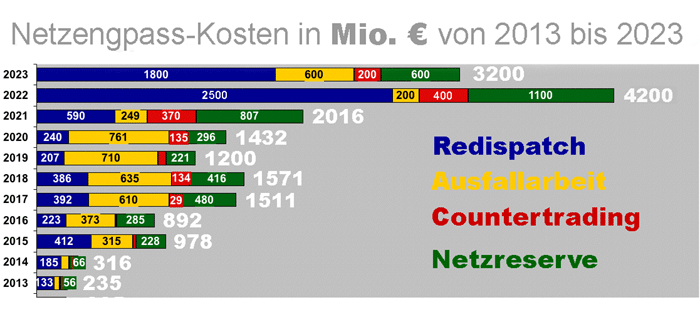 |
| This chart illustrates how grid congestion costs multiplied
between 2013 and 2023. It also shows how the costs for conventional
redispatch (blue) declined for two years after the dissolution of
the German-Austrian electricity trading zone in 2018, but were offset
by an increase in compensation for “outage work” by wind turbines
(yellow). The subsequent shifts in the cost spectrum were due to “redispatch
2.0” and the gas price crisis that culminated in 2022 (231009).
(Note: The individual values given for 2022 and 2023 were only
available in rounded form, which is why their sum differs upwards
or downwards from the total costs shown in Figure
1.
|
Monopoly Commission advocated for at least two price zones in Germany as early
as 2011
It remains noteworthy that the neoliberal-oriented Monopoly Commission advocated
for the introduction of price zones in Germany as early as 2011. In its third
special report pursuant to §
62 EnWG, it considered it economically wrong to try to eliminate grid bottlenecks
solely by building new high-voltage lines. It feared that the resulting costs
could outweigh the benefits. As an alternative, it proposed the introduction
of at least two price zones in Germany. Power plants and electricity traders
would then no longer be able to feed their supplies into the transmission grid
from any point at the same price. Instead, the electricity to be transported
would be auctioned together with the available transmission capacity. In the
event of bottlenecks between the price zones, electricity supplies from outside
would thus be more expensive than those fed into the price zone. These price
differences could encourage power plant operators to build new plants primarily
in areas of high consumption. This would avoid the need to build new transmission
lines to bring electricity from power plants located far from consumption centers
and increase grid stability (see Background,
September 2011).
The Federal Network Agency, however, did not think much of such proposals.
“The discussion about creating several wholesale price zones for electricity
in Germany jeopardizes the planned grid expansion and harms competition in Germany
and Europe,” it stated harshly in October 2011 (111011).
It referred to the results of an expert opinion it had commissioned to counter
corresponding plans by the EU Commission. This report also explicitly rejected
the currently discussed separation of Austria from the EEX trading zone. Five
years later, the agency had to give up its resistance on this point at least
and call on the German transmission system operators to prepare for Austria's
separation (161016).
Ring flows forced the dissolution of the German-Austrian electricity
trading zone in 2018
The separation of Austria from the EEX trading zone was the first and so far
only adjustment of the electricity market design to the actual physical load
on the grid. It resulted from the fact that, starting in 2012, Poland and Czechia
no longer wanted to make their interconnection points with the German electricity
grid available without restriction (120102). The reason
for this was the bottlenecks in the German grid connections with Austria, which
led to ring flows via the grids of these two countries and jeopardized the stability
of their transmission grids. The national grid operators therefore felt compelled
to take technical defensive measures, which were also supported by the European
regulatory authority ACER (150907, 170904,
180112). These ring flows mainly consisted of wind
power generated in northern Germany, most of which could not reach Austria via
the regular routes due to grid bottlenecks.
The Austrian economy in particular was strongly opposed to the dissolution
of the cross-border electricity price zone at the time (161102).
However, it became increasingly clear that there was no way around it because
international pressure was simply too great and the defensive measures against
ring flows were putting even more strain on the bottlenecks in Germany (170501).
As of October 1, 2018, only Luxembourg remained in the EEX trading zone alongside
Germany. The separation decided by ACER just under a year earlier went off without
a hitch, with the wholesale price for Austria now, as expected, higher than
that for the remaining Germany/Luxembourg zone (181003).
This reached another peak in November 2018 with an hourly weighted average price
of €56.68/MWh, but then fell to an unprecedented low of €14.51/MWh by April
2020. This is a fantastically low price when you consider that in June 2024,
the “Phelix base” was still at 77.26 euros/MWh, after having skyrocketed to
465.18 euros two years earlier.
As a precaution, the German government decreed a “uniform
electricity bidding zone” for Germany
Parallel to the debate about the dissolution of the German-Austrian trading
zone, there was already discussion at that time about whether it would not also
be appropriate to further divide the remaining zone within Germany, which would
have to run roughly along the Main River line. The Austrian side even considered
this to be a matter of urgency, because the actual grid bottlenecks were not
the German-Austrian interconnection points, but rather between northern and
southern Germany. However, the incentive to act on this matter was weaker because
there was no international pressure. In addition, in November 2017, the German
federal government at the time decided to amend the Electricity Grid Access
Ordinance, which since then has expressly stipulated a “uniform electricity
bidding zone” within Germany through the newly inserted §
3a (171101). In doing so, it wanted to prevent
the remaining EEX trading zone from being redrawn in a quasi-technocratic manner
by the EU Commission, regulatory authorities, and transmission system operators
following the already scheduled dissolution of the German-Austrian trading zone.
As an alternative to further divisions of the EEX trading
zone, a nodal pricing system was proposed back in 2015, which is now causing
heated debate
However, there were also justified doubts as to whether such a division of
the trading zones would be sufficient and would not have too many negative effects.
At the time, the German Institute for Economic Research (DIW) already took the
view that “targeted, congestion-oriented pricing for the entire German electricity
system” would be the better solution (150907).
This referred to a so-called nodal pricing system, as now called for by twelve
energy economists in an article published on July 10 in the business section
of the Frankfurter Allgemeine newspaper under the headline “The German electricity
market needs local prices.” Among other things, the article stated the following
as justification:
"Redispatch
repairs rob Germany of the efficiency and effectiveness of market-based
price control. So instead of laboriously and incompletely repairing
market intervention with its resulting physically impossible decisions,
the way should be cleared for electricity prices that balance supply and
demand regionally and thus reflect the local value of electricity. The
electricity price on the exchange should be higher where demand is high
and lower where there is currently an oversupply. These conditions
change every minute, so that price differences vary dynamically. Based
on such prices, power plants, storage facilities, imports and exports,
and intelligent electricity consumption can be optimized to benefit the
grid and reduce average electricity costs."
Instead
of the previously uniform nationwide wholesale price, the authors
therefore consider local prices to be necessary, which reflect the
physical and economic reality, rather than adapting this reality to the
electricity exchange fiction of a congestion-free grid at a cost of
billions. Basically, their view is consistent with the aforementioned
research paper “White Paper Electricity Spot Market Design 2030 - 2050,”
but it has now triggered an incomparably greater response. This is
likely due to the fact that this “white paper” was only published in
English, even though it ultimately concerned the German electricity
market design, was predominantly written by German authors and research
institutes, and was funded by the Federal Ministry of Education and
Research. Even among experts, the willingness to translate 61 pages of
scientific Esperanto from English was probably not particularly high.
Eleven trade associations and three trade unions categorically
reject further corrections to the EEX trading zone
However, this changed completely after the same view of things was presented
in a nationwide daily newspaper under the headline “The German electricity market
needs local prices,” which was easy to understand and even provocative to some.
No fewer than eleven trade and industry associations (see 240705)
reacted immediately and rather allergically to this article with a “Joint appeal
by leading trade associations to preserve the German electricity bidding zone”
(PDF).
This appeal was essentially identical to a statement published on July 20, also
in the business section of the “Frankfurter Allgemeine”. What was new here,
however, was that the eleven trade associations were now also supported by the
German Trade Union Confederation (DGB) and its leading individual unions IGM,
IGBCE, and Verdi. Accordingly, the introduction stated:
"Trade unions and trade associations jointly warn against the division
of the unified German electricity bidding zone. The negative effects on the
real economy are incalculable and outweigh any advantages."
That
was essentially the gist of the entire statement, because the
disadvantages and risks that were subsequently put forward are highly
debatable. Ultimately, it remains a question of weighing up whether the
advantages or disadvantages outweigh each other in this dispute over
rather complicated economic and technical issues in theory. In
principle, proponents of a nodal pricing system should acknowledge and
keep in mind certain disadvantages and risks of their preferred method,
just as the trade associations avoided dismissing the “nodal pricing”
they rejected as fundamentally unsuitable in their statement. They were
right to do so, because local prices at certain network nodes or
regional electricity price zones are nothing new. Rather, they are
proven means of bringing the flow of electricity into line with the
technical conditions of the grid in liberalized markets. They have
therefore long been in use in the US and also in several European
countries.
The
joint statement by trade associations and unions in the FAZ was titled
“The energy transition needs a stable foundation.” Everyone will
certainly agree with this platitude. In this case, however, it sounds
more like: “Just don't touch it, because it could get even worse.” In
any case, the current foundation is not stable.
Links (internal)
on grid bottlenecks and redispatch
- Grid bottlenecks cost €4.2 billion last year (231009)
- District heating generated with electricity helps overcome grid bottlenecks
(230603)
- Households to support TransnetBW with redispatch (230205)
- Sharp increase in “outage work” due to curtailment of wind and solar power
plants (221205)
- System services 1.33 billion more expensive than in 2020 (221207)
- Redispatch costs in the first half of the year were ten times higher than
in 2021 (221206)
- Costs for unused EEG electricity rose to 761 million euros (210405)
- Wind power worth over 700 million euros curtailed (200512)
- Redispatch to be standardized – “feed-in management” to be discontinued
(190403)
- Two electricity price zones in Germany would enable savings of one billion
euros (190208)
- “Feed-in management” to disappear after all from October 2020 (181208)
- Redispatch and grid reserves drive spending on “system services” to record
levels (181202)
- Grid stabilization costs rose to €1.4 billion in 2017 (180602)
- German electricity trading zone can now only be divided with government
approval (171101)
on the dissolution of the German-Austrian electricity price zone
- Smooth separation of the German-Austrian electricity trading zone (181003)
- 50Hertz commissioned phase shifter in Röhrsdorf (180112)
- Czechia can block German electricity flows even more effectively (170904)
- Electricity trading with Austria to be restricted from October 2018 (170501)
- Czechia can now also block unwanted electricity flows from Germany (170104)
- Austria continues to resist dissolution of EEX electricity trading zone
(161102)
- From May, the German grid will become even tighter (160307)
- German-Austrian electricity trading zone to be dissolved in 2018 (160201)
- EU regulatory authority demands separate electricity price zones for Germany
and Austria (150907)
- Poland and Czechia want to block unwanted ring flows from Germany (120102)
Links (external, without guarantee)
- PDF Joint appeal by leading trade associations to maintain the German electricity bidding zone (5 pages)
- PDF White
paper Electricity Spot Market Design 2030 - 2050 (This 61-page paper,
which has been available since March 2021, was written by twenty authors
from various research institutions such as TU Munich, FIM/FIT
Fraunhofer, DIW Berlin, and EWI Cologne.)