Why are there grid bottlenecks?
The increase in spot market electricity trading
is the most important reason, but not the only one
(see above)
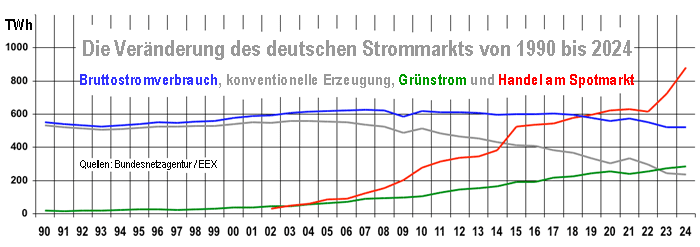
Total electricity consumption in Germany has not changed significantly
in the 35 years since reunification (see blue curve in Figure
1). Last year, at 522 terawatt hours, it was actually 28 TWh lower
than in 1990. So consumption cannot be the reason why grid bottlenecks
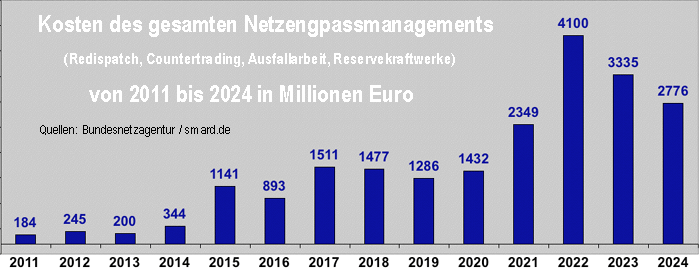
have become so frequent since the second decade that the costs of
so-called bottleneck management have risen 15-fold between 2011 and
2024 (see Figure 2).
The
electricity transmission grid has not become smaller, but significantly
larger: in 1990, the extra-high voltage grid (380 kV and 220 kV) had a
total length of 28,786 kilometers. Today, it is around 37,700
kilometers. It is therefore around a quarter larger. And this has also
increased the transmission capacity.
Nevertheless, despite electricity consumption remaining constant or even falling
since the second decade, this improved grid structure is increasingly
being overwhelmed by electricity flows. As Figure
1 shows, this apparently has to do with the Leipzig electricity
exchange “EEX European Energy Exchange,” which was created in 2002
from the merger of two predecessor companies (011008)
and began spot market trading at that time. The red curve shows that
the traded volume was initially modest at 31 TWh. By 2005, however,
it had already exceeded the total renewable energy generation with
86 TWh, and by 2015 it had also surpassed conventional electricity
generation with 254 TWh. From 2019 onwards, the spot market volume
was even greater than Germany's total gross electricity consumption,
reaching a record high of 880 TWh in 2024. A large part of this volume
is likely to be attributable to cross-border deliveries or pure transits.
At the same time – see green and gray curves – an ever-increasing share of
German electricity consumption was covered by renewable energies,
mainly wind and solar power. As wind power and solar power plants
fed into the distribution grids, the Federal Network Agency warned
in its 2010 monitoring report that this “could lead to temporary grid
bottlenecks in distribution grids.” The feed-in locations of the EEG
plants would “often not fit the original grid architecture.” A provision
known as “feed-in management” in Section
11 of the Renewable Energy Sources Act (EEG) has therefore allowed
grid operators since 2009 to “regulate” EEG plants with a capacity
of more than 100 kilowatts or to shut them down completely if this
measure would otherwise overload the grid capacity (080601).
In the first year after this provision came into force, 73.7 gigawatt
hours of wind power were curtailed (99.8 percent of which affected
wind turbines) and the operators were compensated with over six million
euros in accordance with Section
12 EEG. By 2021, this “outage work” had increased almost eighty-fold
to 5,818 gigawatt hours. The compensation due for this increased 134-fold
to 807.1 million euros.
Large
quantities of wind power were therefore not generated in the first
place because the year-on-year increase in electricity trading clogged
up the bottlenecks in the grid. Nevertheless, the operators were
compensated as if it had been generated. This was acceptable to both the
grid operators and the wind turbine operators, because the compensation
for the “outage work” was paid from the EEG surcharge, just like the
normal feed-in tariffs.
|
|
At
over four billion euros, the costs of “grid congestion management”
peaked in 2022. This was due to the exorbitant rise in gas prices, which
also increased the operating costs of gas-fired power plants for
“redispatch.” Gas prices have since returned to normal. Nevertheless,
grid congestion costs in 2024 were significantly higher than before the
gas price crisis.
|
The sale of EEG electricity on the exchange exacerbated the
problems
In
2010, another regulation came into force that exacerbated the grid
problems and placed an even greater burden on the EEG surcharge to the
detriment of electricity consumers: this was the “Regulation on the
Further Development of the Nationwide Compensation Mechanism of the EEG
(AusglMechV)”. This regulation eliminated the previous procedure,
whereby the quantities of EEG electricity fed into the grid and
subsidized by fixed remuneration were allocated to the end distributors
and their customers' electricity bills in terms of both quantity and
cost. Instead, transmission system operators were now tasked with
recording all EEG electricity and selling it on the stock exchange in
the previous day's spot market trading. This eliminated the direct link
between the EEG feed-in tariff per kilowatt hour and the amounts of
electricity generated.
Since then, it has depended solely on daily stock market roulette whether
the market price achieved even reaches the level of the feed-in tariff
or even becomes negative. In the latter case, transmission system
operators even have to pay a surcharge to get rid of the electricity
at all. Even during the trial run of the new regulation at the end
of 2009, there were several instances of negative prices of up to
€500 per megawatt hour and losses in the seven-digit range (100101).
Since the new regulation did not take effect until 2010, these losses
could not yet be paid for from the EEG surcharge. Instead, they were
booked by the transmission system operators under “system services,”
which also meant they ended up on end customers' electricity bills.
From 2010 onwards, the transmission system operators thus became the largest
electricity traders on the spot market, contributing significantly
to the increase in trading volume and thus to a further narrowing
of the grid bottlenecks. Their initial market share of around 40 percent
then declined again when, from 2012, the “market premium” was introduced
as an alternative to fixed feed-in tariffs, which was primarily intended
to offer operators of larger EEG plants a greater incentive to engage
in “direct marketing” (130201). As a result,
the market share of transmission system operators, which had been
38 percent in 2011, fell to 23 percent by 2013. A further amendment
to the law then ensured that, from 2016 onwards, conventional feed-in
tariffs could only be claimed for existing plants up to 500 kilowatts
and new plants could have a maximum rated output of 100 kilowatts
(140601). For all other
operators of EEG plants, direct marketing via market premiums became
mandatory.
In
its foreword to the 2011 monitoring report, the Federal Network Agency
stated that “the networks have reached the limits of their capacity due
to the large number of transport tasks to be fulfilled in recent years
and the change in the generation structure.” This no longer applied only
to the distribution networks, but above all to the nationwide
transmission network: The main problem was transporting the increasingly
abundant wind power generated in northern Germany via the extra-high
voltage grid to the main consumption centers in the south, because there
was too little demand in the north.
For
this reason, the “feed-in management” system introduced in 2009 was
increasingly combined with conventional “redispatch” to bridge grid
bottlenecks. This means that a certain amount of (wind) power that has
to be curtailed on one side of the grid bottleneck is newly generated on
the other side by gas or coal-fired power plants. The wind power sold
on the spot market and then unable to be transported due to grid
bottlenecks was therefore not generated in the first place, but was
remunerated by the grid operators as “outage work.” On the other side of
the bottlenecks, conventional power plants then generated the same
amount of electricity. In this way, spot market trading appeared to
function just as smoothly as if there were no grid bottlenecks within
the German bidding zone. From the exchange's point of view, everything
was back on track. The costs of these complex and expensive redispatch
procedures did not burden the exchange or its customers, but were passed
on to electricity consumers via grid fees.
In
this way, real grid bottlenecks are still being virtually bridged today
in order to maintain the exchange's fiction of a bottleneck-free grid
within the German bidding zone. This is because it is crucial for
electricity trading on the spot market that a contracted amount of
electricity can be transmitted at the agreed time, regardless of any
real obstacles. Neither suppliers nor buyers need to be concerned with
how this is technically achieved and how it succeeds despite actual grid
bottlenecks. After all, the additional costs for the apparent
“bridging” of grid bottlenecks are borne by electricity consumers.
As early as 2011, the Monopolies Commission pointed to the
alternative that underlies the current ENTSO-E proposal.
 |
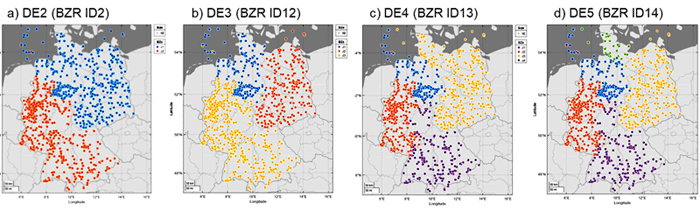
This
proposal by the VDE FNN Committee to divide the German electricity
market into two or three bidding zones dates back to 2014. The
boundaries were drawn up taking into account the grid bottlenecks that
existed at the time.
|
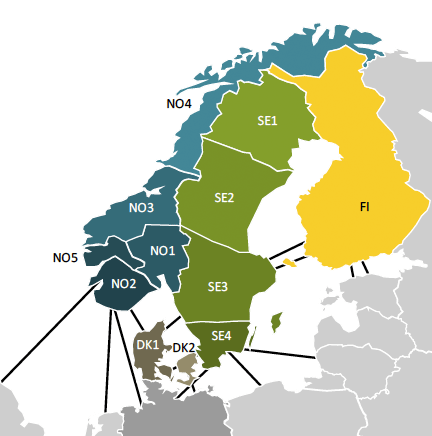
The European electricity market currently comprises a total of 30
countries with 43 bidding zones. Four of these countries have several
bidding zones: Denmark (2), Sweden (4), Norway (5), and Italy (6).
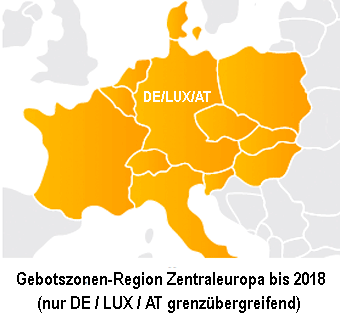
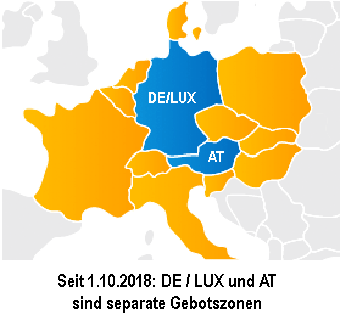
Germany and Luxembourg, on the other hand, have a joint bidding zone,
which also included Austria until 2018. This unique situation arose
from the particularly close economic ties between these three countries
in the electricity sector, which were not affected by any bottlenecks
in cross-border connections. Following the liberalization of the electricity
market in Germany (980401) in 1998 and Austria
(011005) in 2001, the new Leipzig-based electricity
exchange EEX (011008) therefore included
both neighboring countries in its bidding zone.
Until then, there had been no significant bottlenecks in the German-Austrian
grid area despite the liberalization of the electricity market. However,
parallel to the steady increase in electricity trading, the bottleneck-free
zone soon came to an end. Added to this was the general problem that
with the elimination or “unbundling” of the former integrated electricity
supply, overall responsibility for coordinating generation, grid,
and consumption had been lost. Even the establishment of a regulatory
authority, which was delayed for a long time in Germany, could only
change this to a limited extent. A particular problem arose from the
fact that the particularly profitable feed-in from wind power is concentrated
in northern Germany, but often cannot be transported to the main consumption
centers in the south because the necessary grid expansion is progressing
too slowly. As early as 2011, the Monopolies Commission had considered
it wrong to try to eliminate the grid bottlenecks caused by spot market
trading by building “electricity highways”: the better solution, it
said, would be to introduce at least two price zones for electricity
trading within Germany (110907 and
Background). It thus referred to the alternative solution that
now forms the basis of the ENTSO-E proposal to divide the EEX trading
zone into five separate bidding zones (see above).
Nevertheless, the relevant political and economic circles have so far insisted
that maintaining a uniform bidding zone throughout Germany would be
the best solution. When twelve renowned energy economists published
an article entitled “The German electricity market needs local prices”
in July last year, a dozen leading associations reacted quite allergically
with a “Joint appeal by leading trade associations to maintain the
German electricity bidding zone.” These included the most important
electricity industry associations, such as BDEW, VKU, VIK, and BEE.
They were joined by industry associations such as BDI, VDA, VCI, and
ZVEI. A little later, the three major DGB trade unions IGM, IGBCE,
and Verdi also joined the signatories (240704).
|