 |
Source: UBA/DEHSt
|
January 2025 |
260108 |
ENERGY CHRONICLE |
|
Source: UBA/DEHSt
|
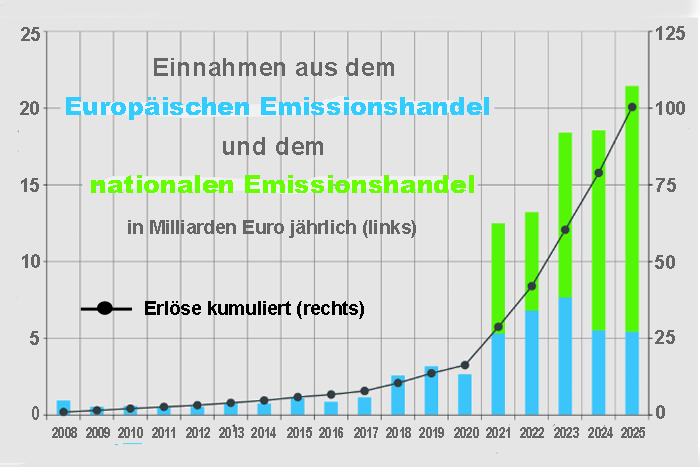
Revenue from European and national emissions trading in Germany amounted to 21.4 billion euros in 2025. This was significantly higher than the previous year's figure (18.5 billion euros). This was reported on January 7 by the German Emissions Trading Authority (DEHSt) at the Federal Environment Agency (UBA). The proceeds from the two central market-based climate protection instruments flow entirely into the Climate and Transformation Fund (KTF), which, as a financing instrument, is intended to make a central contribution to achieving Germany's energy and climate policy goals, but is also used in part for other purposes (260112).
The European Emissions Trading Scheme 1 (EU ETS 1) covers greenhouse gas emissions from energy and energy-intensive industrial installations, intra-European air traffic, and maritime transport. It was launched in 2005, but initially suffered from an oversupply of emission allowances, most of which were issued free of charge, which is why certificate prices only reached a level that could have a climate-protecting effect from around 2018 onwards (see Background, November 2017). In January 2018, an emission allowance (EUA) still cost only €7.83, while the average price last year was €73.86, almost ten times higher. At the same time, the auction volume was further reduced. As a result, the number of EUAs auctioned for Germany, which had been 85 million in 2024, fell to 73.5 million in 2025. The auctions are conducted on the European Energy Exchange (EEX) in Leipzig on behalf of the UBA.
In addition to EU ETS 1, national emissions trading (nEHS) for heat and transport was launched in Germany in 2021. Until 2022, only the main fuels gasoline, diesel, heating oil, liquid gas, and natural gas were part of the nEHS. From 2023, all other fuels, including coal, were added. Since 2024, CO2 emissions from waste incineration plants have also been included. Here, an emission allowance cost an average of €55 in 2025.
In 2025, auction proceeds of around €5.4 billion were generated in the EU ETS 1. This meant that revenues were slightly below the previous year's level (2024: €5.5 billion). In contrast, revenues from CO2 pricing in the national emissions trading system (nEHS) for heating and transport rose significantly compared to the previous year. In the nEHS, revenues in 2025 amounted to around €16 billion, which is around 23 percent above the previous year's figure (2024: €13 billion). Accordingly, total revenues from both emissions trading systems rose compared to the previous year and reached their highest level to date.