 |
|
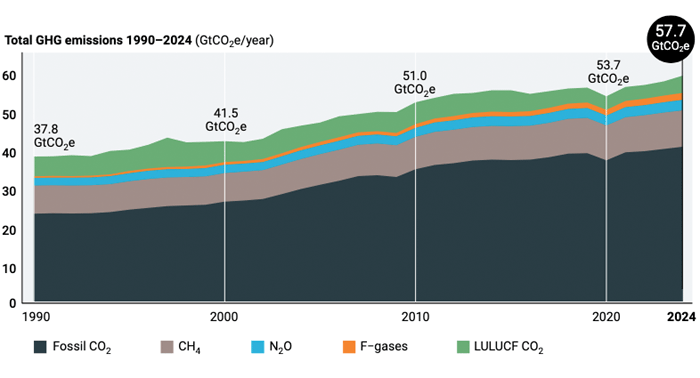
A few days before the start of the 30th World Climate Conference, the United Nations Environment Programme published its Emissions Gap Report (PDF) for this year. According to the report, even if all current climate protection commitments are met, the Earth is still heading for a warming of 2.3 to 2.5 degrees Celsius by 2100. This graph illustrates the report's findings on the inexorable rise in greenhouse gas emissions from carbon dioxide (fossil CO2), methane (CH4), nitrous oxide (N2O), fluorinated greenhouse gases (F-gases), and carbon dioxide from land use, land-use change, and forestry (LULUCF CO2). |
30th World Climate Conference was a predictable disappointment
The 30th World Climate Conference (COP 30), which took place from November 10 to 21 in the Brazilian city of Belem, failed to make any progress in combating global climate change. Given the destructive stance of the US, which withdrew from the Paris Climate Agreement once again after Trump's re-election as president (250101) and boycotted the summit in Belem, this was to be expected, especially since countries dependent on oil and gas production, as well as the energy companies they supply, are feeling a political boost and are once again representing their profit interests more openly instead of focusing on “greenwashing.”
The final declaration does not even mention fossil fuels
The conference's final declaration, which is as long as it is meaningless, does mention the climate and its protection. However, at no point does it mention fossil fuels, the continued use of which has already made the goal agreed upon ten years ago in Paris (COP 21) of limiting the global temperature increase to below two degrees compared to pre-industrial levels (151209) illusory. Apparently, this was the only way to achieve the consensus required for decisions at the UN Climate Change Conference. Instead, reference is made only to a vague formulation at the penultimate World Climate Conference in Dubai, which rather casually considered a move away from oil and gas or a “transition away from fossil fuels in energy systems” to be desirable and was already considered a great success at the time (231214).
“The brakes were too strong this time”
“The old, fossil-fuel world has exploited the geopolitical situation,” summarized Federal Environment Minister Carsten Schneider. “Unfortunately, it has not yet been possible in Belém to agree on a binding roadmap for phasing out fossil fuels for all. The brakes were too strong this time. Brazil's response with voluntary initiatives to phase out fossil fuels and stop deforestation is a good step. Germany will support these initiatives.”
“I
cannot pretend that COP30 has achieved everything that is necessary,”
said UN Secretary-General António Guterres in his statement. "The gap
between where we are and what science demands remains dangerously wide.
(...) We are approaching dangerous and irreversible tipping points.
Limiting warming to 1.5 degrees by the end of the century must remain
humanity's red line. This requires deep, rapid emissions reductions—with
clear and credible plans for the transition from fossil fuels to clean
energy."
Links (internal)
- Trump halts new offshore wind farms and withdraws from Paris Climate Agreement for the second time (250101)
- US withdraws from Paris Climate Agreement (170606)
- List of links to the Rio Climate Convention and follow-up conferences
Link (external, no guarantee)
- PDF Emissions Gap Report 2025 (76 pages)